Tesla ownership · Cabin comfort
Tesla Cabin Filters and When to Replace Them
A stale smell or weaker airflow can make every drive less comfortable. Here is how to tell whether your filters need attention, and when the air conditioning needs a closer look.
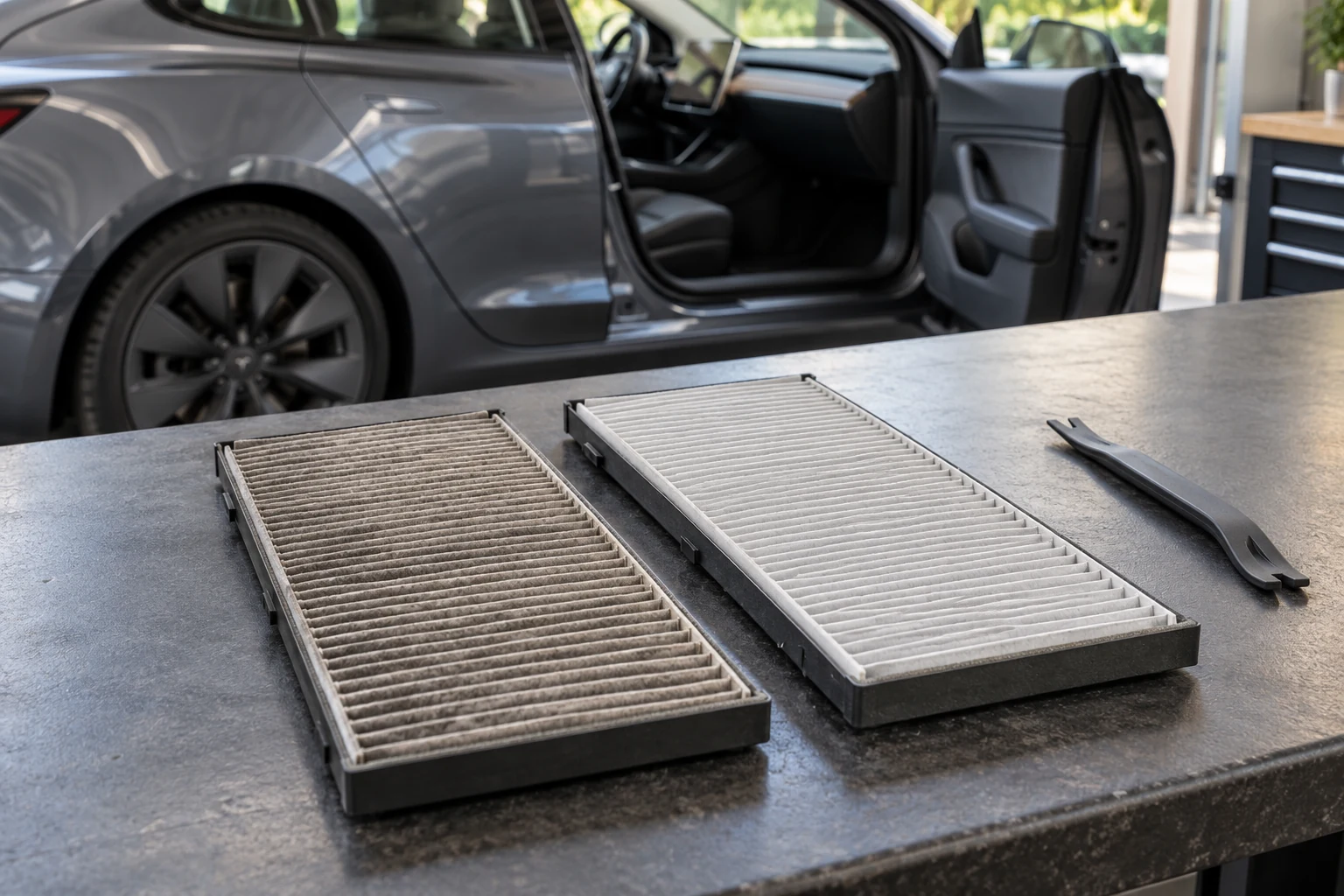
Does your Tesla smell stale when the AC starts, or feel less breezy than it used to? A dirty cabin filter is worth checking. It catches airborne particles before they reach the vents, but a new filter will not fix every smell or cooling problem.
The useful first distinction is weak airflow versus air that is not cold enough. Note which one you are experiencing, then check the filter history. That gives you a better starting point than ordering parts because the cabin feels uncomfortable.
Signs worth checking
Pay attention to what has changed and when it happens. A symptom helps narrow the inspection, but it does not prove that a filter has failed.
Less air from the vents
If the fan sounds busy but the airflow feels weak, check the vent settings and filter condition. Compare the same fan setting with your usual experience. A restriction is one possibility; the blower and air distribution also deserve attention if fresh, correctly fitted filters do not resolve it.
A smell at startup
Tell the workshop whether an odour lasts a few seconds or stays throughout the drive. Filters are one inspection point, but a persistent smell needs the rest of the ventilation system checked too. Replacing filters repeatedly without finding the cause can leave you with the same problem.
Strong airflow, warm air
When airflow is strong but the cabin stays warm, have the cooling problem assessed rather than assuming new filters will solve it.
Describe the symptom before ordering parts
The most useful description is specific. “The AC is bad” can mean a weak fan, poor cooling, a brief smell or a vent that has been turned off. Note the conditions that bring the complaint on, then compare like with like.
| Pattern | What to record |
|---|---|
| Airflow changes during a drive | Whether Auto is selected, which outlets are active, and whether the change follows a temperature adjustment. |
| One outlet feels weak | The selected vent direction and whether the same outlet can be adjusted normally. Do not assume a whole filter set has failed. |
| A brief smell at startup | How long it lasts and whether it occurs after particular parking or weather conditions. |
| An odour remains after replacement | Which filters were changed, when, and whether the smell changed at all. |
| Strong airflow stays warm | The temperature setting, outside conditions and whether cooling improves while driving. |
Swipe the table sideways if needed.
In Auto, Tesla’s climate system can change fan speed and distribution as it works toward the requested temperature. Some supported configurations also reduce fan speed during calls. A brief change in airflow is therefore not automatically evidence of a blocked filter. Use the climate instructions for your vehicle to distinguish a setting from a persistent symptom.
Do these observations while safely parked. There is no need to dismantle the console, put objects into a vent or disconnect electrical parts just to describe the complaint.
When replacement is due
Tesla’s UAE maintenance guidance lists the intervals below. Your vehicle’s manual and maintenance record are the starting point, especially if it is an import or has a different build specification.
| Vehicle | Recommended interval |
|---|---|
| Model 3 and Model Y | Every 2 years |
| Model S and Model X, produced after 2020 | Every 3 years |
| Model S, 2012–2020; Model X, 2015–2020 | Every 2 years |
Swipe the table sideways if needed.
Tesla recommends replacing HEPA and carbon filters every three years on vehicles equipped with that system. Environmental conditions can change the schedule.
On vehicles with supported software, Controls > Service > Maintenance shows due items and completed work. Tesla specifies software 2024.44.25 or later for this feature. Record the actual replacement, rather than resetting a reminder without doing the work.
Dust exposure and a change in airflow are reasons to inspect the filters before a scheduled date. They do not justify one blanket replacement interval for every car in Dubai. If you bought the vehicle used and the previous replacement date is unknown, an inspection can establish a sensible baseline.
Cabin filters and HEPA
A cabin filter and a separate HEPA filtration system are not interchangeable parts. Before ordering, identify the model, build year and fitted equipment. “Fits Tesla” is not enough information to select a replacement.
Do not assume that all Model S, 3, X and Y vehicles share the same filtration arrangement. A product described as a HEPA cabin-filter upgrade is also not proof that the car has Tesla’s factory HEPA system or Bioweapon Defense Mode.
Match the filters to the build
- Model 3 has cabin filters. Tesla’s owner procedure shows a two-filter arrangement, with cover fasteners that can vary by build.
- Model Y has a cabin-filter schedule and, where fitted, a separate HEPA and carbon-filter schedule. Confirm the fitted equipment before ordering either set.
- Model S and Model X need their production year checked for the cabin-filter interval. Apply the separate HEPA interval only if that equipment is fitted.
Use the VIN and production details to match parts and access instructions. Do not infer factory HEPA equipment solely from an aftermarket filter labelled “HEPA”.
For either genuine Tesla or aftermarket parts, ask for the manufacturer and exact vehicle compatibility. Correct dimensions, sealing and the specified airflow direction matter. Price or packaging alone does not establish whether a filter is suitable.
What each filtration stage does
The cabin filter is part of the heating, ventilation and air conditioning system, often shortened to HVAC. The blower moves air, the vents distribute it, and the cooling system controls temperature. The filter’s job is to capture particles from that airflow. Identifying which job has changed makes the next check more useful.
Particles and odours need different media
Pleated particle-filter material and activated carbon perform different roles. On HEPA-equipped Model Y vehicles, Tesla describes highly effective particle filtration and activated carbon for a broad range of odours and gases. Carbon does not remove every gas effectively, including carbon monoxide. A filter system should never be treated as protection that makes harmful fumes safe.
HEPA means High Efficiency Particulate Air. A replacement marketed with that term is not enough to establish that it is the correct part for the factory system. Ask which assembly it replaces, how it fits and whether its specification applies to the actual vehicle.
Fresh air and recirculation
Fresh-air operation draws air from outside; recirculation reuses cabin air. Tesla’s Model Y manual describes the fitted HEPA system working with incoming outside air when recirculation is off. Its Bioweapon Defense Mode adds positive cabin pressure. These equipment-specific functions should not be assumed for every Tesla.
Recirculation is a climate setting, not a substitute for overdue filters or a diagnosis of an odour. If a smell changes with that setting, record the difference and explain it during inspection. It is one observation among several, rather than proof of where the problem originates.
Checks before booking
With the car parked, collect a few useful observations. You do not need to remove panels to explain the problem.
- Separate airflow from temperature. Is there less air, warmer air, an odour, or more than one symptom?
- Check the settings. Note the fan speed, selected vents and whether the problem occurs with both fresh air and recirculation.
- Find the last replacement. Look at receipts or the Maintenance Summary, where supported by your vehicle’s software.
- Record the pattern. Mention whether the problem happens at startup, after parking in the sun or throughout the journey.
- Share the model and year. The workshop can confirm the fitted filter arrangement before ordering parts.
A photo of an old filter can help show its condition if it has already been removed. Avoid dismantling the dashboard just to take one.
Replacing the filters
Tesla provides instructions for owners who want to replace the cabin filters on a Model 3. Whether you do it yourself or book a workshop depends on the correct procedure, access, tools and your confidence working with trim and connectors.
Follow the procedure for your exact vehicle. Cover fasteners and access arrangements can differ. Do not pull on wiring or disturb orange high-voltage cables. Stop if you encounter damaged cables or an arrangement that does not match the instructions.
If you prefer a workshop replacement, ask for the filter type to be identified first. After fitting, check airflow and confirm whether the original complaint has gone. Keep a record of the replacement date, and update the Maintenance Summary where applicable.
If an odour or cooling issue remains, explain that before approving more parts. A filter change should not be treated as proof that the rest of the AC system is working correctly.
Choose a replacement that fits
A useful filter order identifies the vehicle and the exact assembly being replaced. A low headline price may describe one filter, a cabin-filter pair or a different HEPA assembly, so compare the contents rather than the product name alone.
- Vehicle applicability should identify the relevant model and production version, with confirmation from the VIN where needed.
- Parts supplied should state the number of filters and whether cabin filters, HEPA filters or carbon components are included.
- Material and condition should match the stated product. A dark carbon-containing filter is not necessarily dirty simply because of its colour.
- Installation should use the correct housing, sealing and airflow direction. A distorted element or poorly seated cover deserves correction.
- Price should distinguish parts and fitting, applicable VAT and any separately agreed investigation of a persistent smell or cooling problem.
For the supported Model 3 procedure, Tesla identifies upper and lower filters and specifies their arrow direction. Access fasteners can differ by manufacture date. Follow the exact instructions instead of using a video for another build as the authority for every vehicle.
After replacement, check that the trim and cover are secure and that the original airflow complaint has improved under comparable settings. Keep the receipt and actual completion date. Maintenance Summary is useful for the next due date when its records accurately reflect the work completed.
When a smell keeps returning
A short-lived improvement after changing filters does not establish that another filter set is the answer. Give the technician the timing of the recurrence, parking conditions and whether the smell is present with cooling switched on and off.
The inspection may need to extend to the HVAC housing, evaporator area, drainage and signs of moisture rather than stopping at the visible filter. The evaporator is the cooling heat exchanger in the ventilation system; it is a separate inspection point from the filter element. These are possible areas to assess, not a diagnosis made from an odour description.
Do not pour cleaners into the vents or spray an unspecified chemical into the housing. If cleaning is recommended, ask which component needs it, which product and procedure are appropriate, and whether that work is included in the quote. Fragrance that masks an odour is not evidence that its source has been removed.
If the smell accompanies evidence of water entering the cabin, mention that history. If it is a burning smell, smoke or an electrical warning, stop treating it as routine filter maintenance and arrange appropriate assistance. A new filter should not be used to dismiss a different problem.
Common filter questions
Will new filters make the AC colder?
They may improve airflow when the old filters are restricting it. They do not repair a refrigerant, compressor or control fault. Strong airflow that stays warm calls for a cooling-system assessment.
Can I wash the old filters?
Only if the filter manufacturer explicitly identifies them as washable and gives a cleaning procedure. Do not assume that a disposable pleated filter can be restored by washing or blowing it out.
Should every Dubai Tesla get yearly filters?
Not automatically. Use the recommendation for your vehicle, the maintenance history and the condition of the filters. Heavy dust exposure or a new symptom can justify an earlier inspection.
Will a filter change improve driving range?
Do not expect a promised percentage increase. Cabin temperature, weather, driving and other loads affect energy use. Replace a filter for its condition and maintenance needs, rather than treating it as a guaranteed range upgrade.
Vehicle instructions and sources
Checked 30 September 2026. Use the manual associated with your own car for its equipment, control labels and access procedure.