Tesla ownership · Cabin comfort
Tesla AC Warm Air and Weak Airflow
Your cabin feels hot, but is the problem warm air or too little air? Understand the difference before paying for recharge or replacement parts.

Strong airflow that stays warm needs a cooling assessment. Weak airflow needs the settings, filters and blower checked. A refrigerant recharge can help when an incorrect charge is established, but it will not repair every AC problem.
Start with what has changed, keep owner checks to the controls and visible symptoms, and use the procedure for your actual Tesla configuration. If a vehicle warning tells you to stop, follow it before investigating cabin comfort.
Separate warm air from weak cabin airflow
If the fan moves plenty of air but it stays warm, describe the complaint as a cooling problem. If little air reaches you even with a higher fan setting, describe it as weak airflow. Both can happen together, but they need separate checks. Refrigerant recharge addresses the refrigerant circuit. It does not unblock a filter, restore a failed blower or correct every temperature-control problem.
| What you notice | Useful first distinction | What recharge can establish |
|---|---|---|
| Strong airflow that stays warm | Check settings, cooling operation and the refrigerant circuit | It may help if the charge is incorrect and the cause is addressed |
| Little air despite a higher fan setting | Check vent selection, filter condition and blower operation | It will not repair an airflow restriction |
| Cooling changes between parking and driving | Record the conditions and check thermal-system operation | The pattern alone does not prove low refrigerant |
| One side feels warmer | Compare left and right settings and air direction | Do not diagnose a refrigerant or valve fault from this alone |
A hot cabin immediately after parking in the sun is different from air that remains warm once cooling has had a reasonable opportunity to work. Record whether the temperature improves, stays the same or becomes worse. Avoid choosing a replacement component from that observation alone.
Check the climate settings before assuming failure
With the vehicle safely parked, confirm that climate control is enabled and that the requested temperature is below the cabin temperature. Check the selected vents and air direction. If the vehicle has separate left and right temperature settings, compare them. A setting that directs air away from you can feel like reduced airflow even when the blower is operating.
Try the normal automatic climate setting described in your vehicle’s manual, then note what changes. Some Tesla configurations manage fan speed automatically while reaching the requested temperature. Do not compare two journeys without also checking the fan setting, vents, cabin temperature and whether you were charging.
Observe the system rather than repeatedly changing every control at once. For example, keep the same selected vents while comparing fan settings. Then note whether the amount of air changes. This gives a workshop a clearer description than saying that the AC is “weak” without separating temperature from airflow.
- Airflow: Does the air volume change when you select a different fan speed?
- Temperature: Is the air warm throughout, or does it cool before becoming warm again?
- Conditions: Does the problem happen after sun parking, during charging, when stationary or throughout the journey?
- Warnings: Record the exact alert wording and follow the vehicle’s instructions.
Preconditioning through the Tesla app can make a hot cabin more comfortable before departure. It is not a test that proves the AC is fault-free, and normal use of a lower temperature setting is not evidence that an owner has damaged the compressor.
Understand restricted airflow and cabin filter condition
When the fan sounds busy but little air reaches the selected vents, filter condition is one inspection point. Also check the vent settings and whether the symptom affects every outlet or only one area. A fresh filter should not be offered as the answer to every complaint about cabin temperature.
Check the filter replacement record before agreeing to another change. Tesla’s UAE guidance uses different schedules for different vehicles and fitted filtration systems. Environmental exposure can justify inspection, but there is no single 10,000–12,000 km rule for all Tesla models in Dubai. Use the current recommendation for the vehicle and the actual condition of its filters.
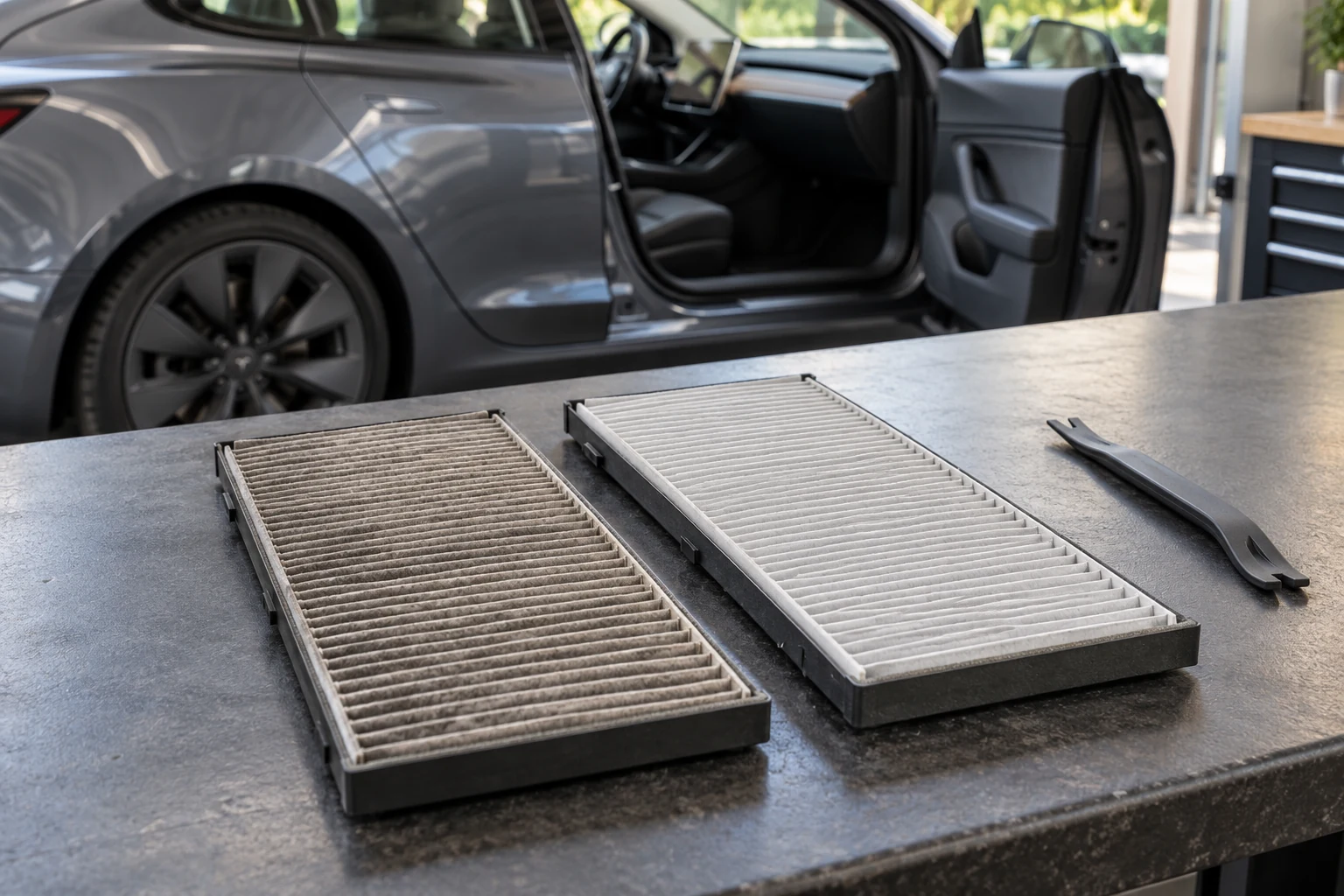
If the airflow remains weak after correctly selected filters are fitted, return to the original complaint. Ask whether blower response, air distribution or another restriction has been checked. If a smell is the main problem, describe how long it lasts and when it appears. A smell alone does not establish mould, a refrigerant leak or a failed compressor.
Know when refrigerant recharge can actually help
Recharge can help when an incorrect refrigerant charge is established and the system is serviced using the applicable procedure. It may also be part of a repair that requires opening the refrigerant circuit. It should not be sold as the automatic answer to warm air, weak airflow or every seasonal AC check.
Ask why recharge is being recommended. Was the refrigerant quantity checked through the applicable recovery procedure? Was there a known leak, a previous component repair or a documented charging error? A pressure reading by itself is not the same as a measured refrigerant quantity, and the diagnosis should account for operating conditions.
A known leak needs attention. Tesla’s current 2024+ Model 3 procedure warns against recharging a system with a known leak except within its specified leak-detection procedure. A diagnostic recharge in that controlled process is different from repeatedly topping up a leaking car to get temporary cooling.
After repair, the question is whether the original complaint has gone under relevant conditions. Cold air immediately after adding refrigerant is useful, but it does not establish that a previously identified leak has been repaired. Keep the findings and completed work together in the service record.
Match the procedure to your Tesla configuration
Model 3, Model Y, Model S and Model X do not all use one thermal-system arrangement. Heat-pump and non-heat-pump vehicles need the relevant service information. Build period, market and fitted equipment can change the procedure, parts and refrigerant specification.
On supported vehicles, Tesla’s UAE guidance identifies heat-pump equipment through Controls → Software → Additional Vehicle Information. If the screen or menu does not match, use the manual for the vehicle or ask the workshop to identify the configuration. A similar-looking dashboard is not sufficient evidence that two cars share the same AC hardware.

Refrigerant, compressor oil and liquid coolant are separate specifications. Tesla’s service information requires the specified refrigerant and oil and warns against mixing types. Do not assume that a car imported into the UAE has the same specification as another vehicle of the same model. The vehicle identification and information label matter more than a generic “Tesla gas” description.
The same caution applies to quoted quantities, vacuum duration and commissioning steps. Use the applicable procedure rather than one figure copied across every model and year. This guide deliberately leaves those workshop specifications to the identified vehicle.
Describe changing cooling without guessing the cause
If cooling is better while moving than while stationary, tell the workshop that exact pattern. Airflow through heat exchangers, fan operation and thermal-system control may need assessment. The symptom does not establish that a fan has failed or that adding refrigerant will solve it.
Use observations from normal journeys. Do not conduct a road test that distracts you from driving. Note whether the cabin was already hot, whether cooling later recovered and whether any warning appeared. Compare similar settings when possible, and explain if the problem is intermittent rather than present every time.
Charging adds another condition worth recording. Tesla’s Model 3 manual explains that cooling demand during charging can affect the air from the vents in some circumstances. A change limited to charging is therefore useful context. Persistent poor cooling outside that situation still deserves assessment, rather than being dismissed as normal.
Noise needs the same care. Some fan and compressor sounds are part of normal thermal-system operation. Record a new grinding, scraping or other unusual sound and when it occurs, but do not identify a failed component from the sound alone. Keep away from moving fans and leave panels and electrical connections undisturbed.
Expect diagnosis before approving refrigerant or parts
A useful assessment begins with your complaint and vehicle configuration. Ask for the airflow and cooling findings to be explained separately. If the recommendation changes from recharge to component replacement, ask what additional finding supports that change.
- Confirm the symptom: Reproduce weak airflow, warm outlet air or intermittent cooling where practical.
- Check operation: Review the relevant controls, alerts and system responses instead of assuming that an alert-free vehicle has no fault.
- Assess the refrigerant circuit: Use vehicle-specific recovery, charge and leak-detection procedures when the findings call for them.
- Repair the identified issue: Match the component, connection or service work to the evidence.
- Verify the result: Check the original complaint again and perform the required thermal or HVAC tests.
Tesla publishes different service routines for these operations. Its current 2024+ Model 3 recharge procedure includes commissioning and thermal/HVAC performance tests. That is a vehicle-specific example, not a set of owner instructions or proof that every workshop has the same diagnostic access.
A recharge quotation and a diagnostic quotation may cover different work. Ask whether leak investigation, recovery, required materials and the final check are included. If further work needs approval, have the additional charge and reason explained before it begins.
Keep owner checks outside the refrigerant circuit
Useful owner checks involve settings, symptoms and maintenance records. Leave service ports, refrigerant handling, compressor connections and high-voltage work to appropriately trained technicians. A recharge can and a generic gauge cannot replace identification of the system or its required procedure.
Do not add leak-stop products, unspecified oil or a different refrigerant. Do not attempt to pressure-test the system with compressed air or vent refrigerant. Tesla’s service guidance includes specific equipment, handling and contamination precautions because incorrect work can injure people or damage the thermal system.
If a warning instructs you to stop or limits vehicle operation, follow it. Stop safely and seek assistance if visibility cannot be maintained, smoke appears or an electrical burning smell develops. A cooling complaint should not be used to override a separate vehicle warning.
For ordinary comfort problems without an urgent warning, collect the model, year, settings and symptom pattern before arranging assessment. Avoid repeated resets or improvised cleaning as a substitute for diagnosis. In particular, do not remove trim or direct a pressure washer into cooling components to investigate weak AC.
Separate scheduled maintenance from an AC fault
Filter replacement, desiccant servicing and fault diagnosis answer different questions. A scheduled item becoming due does not prove that it caused the current complaint. Likewise, a recent service does not prove that every part of the cooling system is working correctly.
Check Tesla’s current UAE maintenance guidance and the vehicle’s Maintenance Summary where supported. Heat-pump configuration matters to the desiccant recommendation. Do not turn a component’s scheduled replacement into a blanket annual refrigerant top-up or claim that routine servicing completely prevents failure.
Keep receipts that identify the work and parts used. If cooling has changed since a repair, provide that sequence to the workshop without assuming that the repair caused the new symptom. A clear record makes it easier to compare the previous finding with the current complaint.
Answer common questions about cooling and recharge
Will recharge make weak airflow stronger?
It will not repair a blocked filter or restore a failed blower. Separate how much air reaches the vents from how cold that air is before choosing the work.
Does warm air always mean low refrigerant?
No. Check settings and system operation, then investigate the refrigerant circuit where appropriate. Warm air is a symptom, not a measured charge quantity or a compressor diagnosis.
Should every Tesla get annual refrigerant top-ups?
No blanket interval applies. Use the vehicle’s maintenance guidance and investigate cooling complaints. Scheduled desiccant maintenance is different from automatically adding refrigerant each year.
How long should a proper recharge take?
There is no universal appointment time for every model and fault. Ask which vehicle-specific procedure and checks are included, and whether leak investigation or component repairs are also needed.
Before your next appointment, write down one sentence that separates airflow from temperature. Add when the symptom happens and any exact warning wording. That gives the assessment a useful starting point without committing you to recharge or replacement.
Official references for vehicle-specific AC service guidance
- Tesla Model 3 climate controls
- Tesla UAE maintenance guidance
- 2024+ Model 3 refrigerant recovery and recharge
- 2017–2023 Model 3 refrigerant and oil specifications
Use the manual and service information that match the vehicle’s build and market.