Tesla owner guide · Noise troubleshooting
Tesla Clicking, Creaking and Clunking Explained for Owners
Describe the sound, its timing and any handling change before drawing conclusions about a failed part.

A Tesla clicking, creaking or clunking sound is easier to investigate when you record when it happens, where you hear it and whether the car’s handling has changed. Sound alone cannot identify a failed control arm. If steering or braking feels unsafe, stop somewhere safe and seek assistance before trying to reproduce the noise.
Check handling changes before investigating the sound
Start with how the car behaves, rather than how loud the noise seems. Has steering become unexpectedly heavy, loose or difficult to control? Does the car pull suddenly, feel unstable or brake differently? A new sound accompanied by these changes needs more urgent attention than an isolated familiar click during a documented operating event.
If you cannot control the vehicle normally, bring it to a safe stop and arrange assistance. Do not continue a listening drive or deliberately brake hard to investigate it. Follow any displayed instruction to stop, and tell the assistance provider the exact alert. Tesla’s Model 3 manual directs owners to contact Tesla immediately for problems with the braking system.
- Steering change: Explain any new resistance, looseness or difficulty maintaining direction.
- Braking change: Report unusual pedal behaviour, reduced stopping ability or an accompanying brake warning.
- Vehicle stance: Mention a new lean or reduced wheel clearance, without assuming a height sensor has failed.
- Vibration or contact: Describe shaking, scraping or rubbing that appeared with the sound.
The absence of an alert is useful information, but it does not confirm that the suspension, tyres or brakes are sound. An online article cannot clear a car for continued driving. If the situation is uncertain, describe the symptoms to a qualified technician before deciding whether to drive to an appointment.
Compare the conditions that bring out noises
“A front clunk” leaves several questions unanswered. “One clunk when moving forward after reversing, with the steering straight” gives a technician a clearer starting point. Keep the observation separate from your explanation of it. You can describe a pattern accurately without naming a component.
| Condition | Useful detail | What remains uncertain |
|---|---|---|
| Parked | Waking the car, selecting a drive mode, turning the wheel or changing ride height. | Whether the sound comes from suspension, tyres, brakes or another operating system. |
| Slow turning | Left or right turn, forward or reverse, and whether the wheels are rolling. | Which joint, mounting, contact point or other source needs attention. |
| Braking | Pedal application, stopping, Hold engagement or release. | Whether the sound is a brake event or another component responding to the same movement. |
| Bumps | Front or rear, one wheel or both, and compression or settling afterward. | Which component produces the noise under that particular load. |
Use this comparison to organise what you already noticed. It is not a sequence of driving tests. A sound that occurs under several conditions should be reported under each one. Conversely, a parked click and a bump-related knock may be separate concerns, even if you noticed them on the same day.
Separate parked sounds from moving suspension noises
First establish whether the car is genuinely stationary when the noise occurs. Note whether you have just approached it, opened a door, selected Drive or Reverse, or released the parking brake. These moments differ from a repeated creak while the car travels over uneven ground.
Tesla’s current Model 3 operating-sounds guide describes a parking-brake thump, a brake tick when leaving Park and a floor click as the battery contactors close. These examples apply to the described operating events. They do not establish that every thump or click in a Model 3 is normal, or that another Tesla has identical equipment.
If a sound occurs while turning the steering wheel with the car parked, distinguish it from a sound heard only while rolling. Record the surface beneath the tyres and whether the sound seems to come from a wheel area or inside the cabin. Do not repeatedly turn the wheel against its end stop to make the sound louder.
A hum near the front of the car also needs a different description from a sharp suspension knock. Note any climate operation or ride-height adjustment occurring at the time. Avoid switching multiple settings simply to chase the sound, because doing so makes the original circumstances harder to describe.
If the noise continues while nobody is touching the controls, say so. If it happens once after the car has been parked for several hours and then disappears, preserve that detail too. A one-off event and a repeatable mechanical noise should not be bundled into the same description.
Describe what happens during low speed turns
For noise noticed during normal parking or manoeuvring, record the direction and approximate speed. Does it happen on both left and right turns? Only in reverse? Near the beginning of steering movement or at a particular angle? Is it one click or a series of clicks as the car moves?
These details help separate steering movement from wheel rotation and vehicle movement. A stationary creak, a rolling click and a scrape on one tight turn are different observations. None identifies an upper control arm, wheel bearing or drive joint by itself.
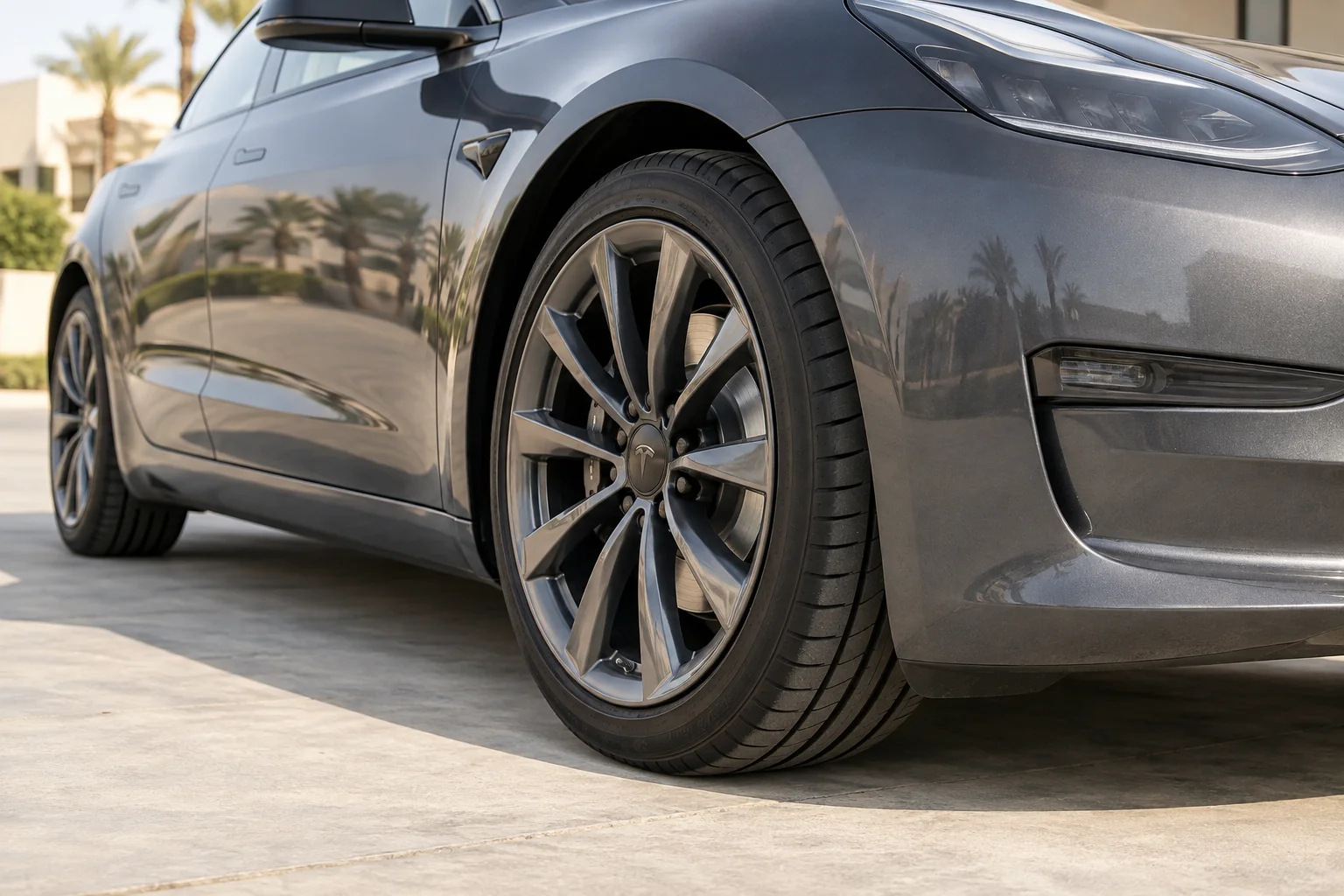
The current Model 3 manual also describes tyre or brake creaking in specified situations, including front-tyre sounds during steering. Compare the actual circumstances with the manual for your car. A new persistent sound, rubbing or changed steering feel still needs assessment, even when its description resembles an example in that guide.
Surface information is useful. State whether you were on a smooth car-park floor, tarmac or a ramp. Describe what occurred on your ordinary route without seeking out tighter turns or changing speed to provoke it. If the technician needs a controlled comparison, let them decide how to conduct it safely.
Notice whether braking changes the same noise
Explain whether the sound occurs as you press the brake pedal, while slowing, at the final stop or when moving away again. A click heard from the driver’s footwell is different from a knock perceived near a rear wheel. Note whether you can feel anything through the pedal as well as hear it.
Tesla documents a faint footwell sound when Vehicle Hold initially engages on the current Model 3. The corresponding Hold indication helps identify the event. That description is not reassurance for a pedal that feels wrong, reduced braking performance or a brake-system alert.
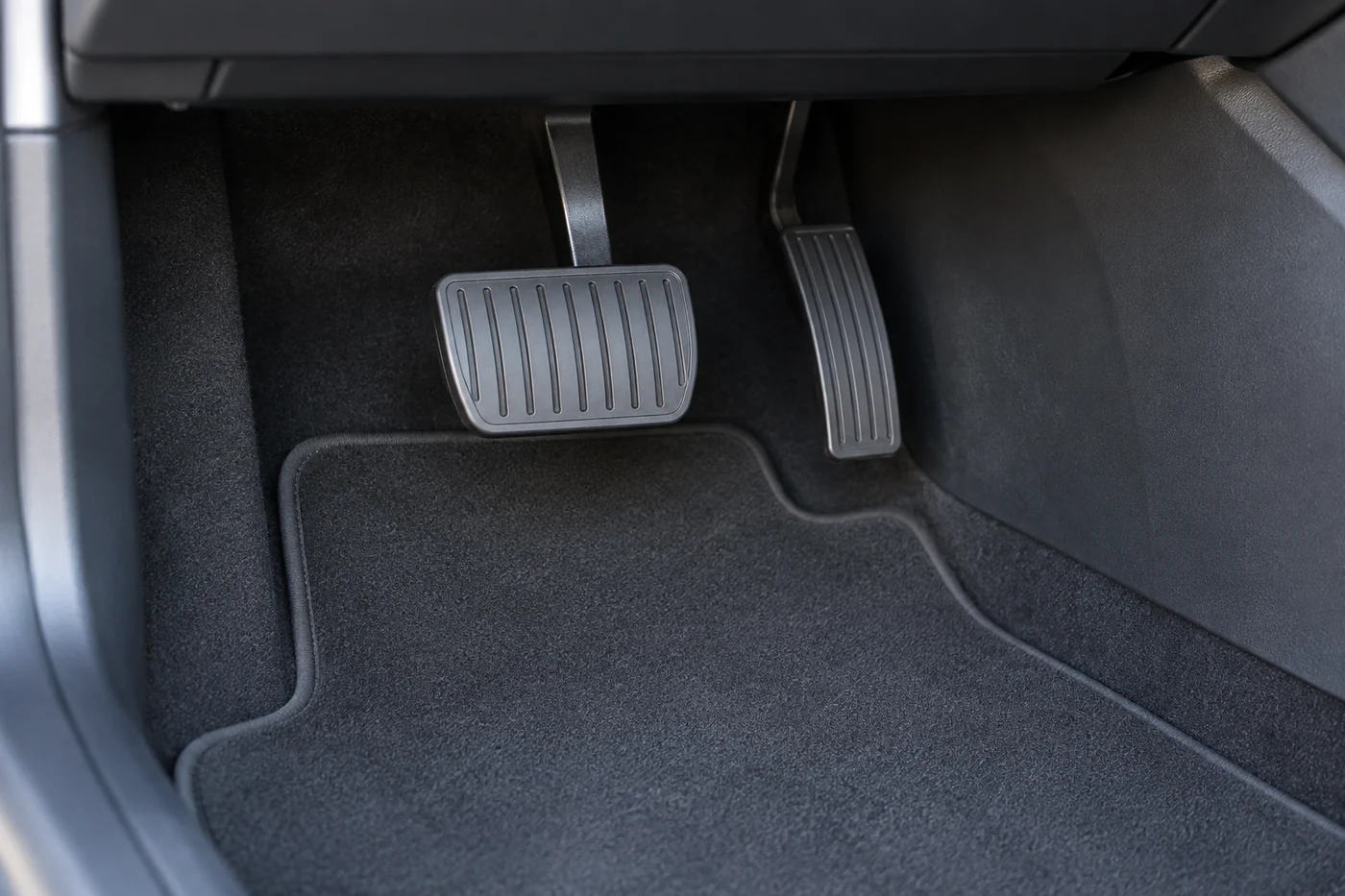
Distinguish slowing after lifting off the accelerator from slowing after applying the brake pedal. If you only remember that the car was decelerating, say that instead of assuming which system was responsible. Do not disable features or perform repeated heavy braking to make this distinction.
Braking and suspension movement can occur together, so timing alone does not prove that brake pads or a suspension joint caused the sound. A technician needs to relate the complaint to an inspection. If you also see a brake warning, record the full message and follow its instructions rather than treating it as part of the noise alone.
Record bump noises without recreating hard impacts
For a noise noticed over an ordinary speed hump or uneven road, describe when in the movement it occurs. Was it as the front wheels reached the hump, as the rear wheels followed or as the body settled afterward? Did one side of the car cross the uneven area first?
Record whether it was a single dull knock, repeated rattling or a longer creak. These words are descriptions, not diagnoses. A sharp sound does not automatically mean a loose fastener, and a dull sound does not automatically mean a worn bushing. The same perceived location may require checking several nearby components.
Also note normal loading, such as passengers or luggage, and any change in ride behaviour. Unexpected bouncing or instability should be reported alongside the noise. You do not need to add weight, bounce the body manually or repeatedly cross the same bump to create more evidence.
If the concern began after striking a pothole or kerb, give the date and circumstances. An impact introduces a separate tyre and wheel damage question that needs its own assessment. This noise guide does not determine whether an impacted wheel or tyre is safe. Avoid recreating the impact or treating alignment alone as proof that damage has been ruled out.
Make a useful record before your inspection
A short written record is often easier to interpret than several clips with no explanation. Start with the model, year or production period, mileage and when you first noticed the sound. Include recent work, changed tyres or wheels, and any event that preceded it. A change after repair deserves investigation, but timing alone does not establish that the work caused it.
- When it began: Record the date or your best estimate, and whether onset was sudden or gradual.
- Operating condition: State parked or moving, forward or reverse, turning direction and braking involvement.
- Perceived location: Use front, rear, left, right, footwell or underneath. Mark uncertain locations as uncertain.
- Frequency: Describe one event, each steering movement, each bump or an intermittent occurrence.
- Accompanying change: Include handling, pedal feel, vibration, vehicle stance and exact warning text.
- Surroundings: Note road surface, weather and whether the car had been parked or driven beforehand.
A safe sound recording can support the description. Record while parked when that captures the concern, or let a passenger record during an otherwise normal journey that is safe to undertake. The driver should not handle a phone or divide attention between recording and driving. Keep anyone recording outside clear of moving vehicles.
Phone audio can make a small click sound loud or obscure a low-frequency knock. Preserve the original file and explain where the phone was placed. Include a date, approximate speed if relevant and what happened just before the sound. Do not label a clip “failed control arm” unless that has actually been confirmed.
Match operating sounds to the fitted equipment
Use the owner information for the actual vehicle rather than applying one model’s examples to the entire range. Registration year, production period, market specification and installed suspension matter. A manual section about air suspension does not apply merely because a car carries a Tesla badge.
For the current Model S and Model X covered by Tesla’s UAE air-suspension manuals, the compressor may be heard at startup as its reservoir fills. This is a documented operating sound. A sound accompanied by a new lean, unusual height behaviour or an alert needs to be described separately.
Those manuals distinguish a yellow indicator for reduced adaptive air-suspension performance from a red indicator for a fault that disables the system. They direct owners to contact Tesla if the yellow problem persists, and to contact Tesla for the red condition. Follow the actual message and describe any clearance or handling change.
On a car with adjustable suspension, note the setting already in use when the sound happened. Do not repeatedly raise and lower the vehicle to estimate compressor health. There is no universal stopwatch test here that proves a compressor, valve or sensor has failed.
Ambient conditions belong in the record, but being in Dubai does not prove a heat-related suspension fault. A sound noticed on a hot afternoon is an observation about timing. It is not evidence that bushings softened, sensors drifted or a compressor overheated. The explanation must follow the findings for that car.
Understand what a technician needs to inspect
The first task is to identify the concern and decide whether a road test is appropriate. The technician needs your description, relevant history and the exact operating condition. An intermittent noise that cannot be reproduced should remain an unresolved concern, rather than becoming a confirmed failure because a familiar component name seems plausible.
Tesla’s front-suspension inspection procedure for 2017–2023 Model 3 includes checks of control-arm joints and boots, link bushings, excessive play and contact with the front aeroshield panel. It uses different inspection positions for different checks. That is a professional procedure, not an instruction for an owner to lift the car or crawl underneath it.
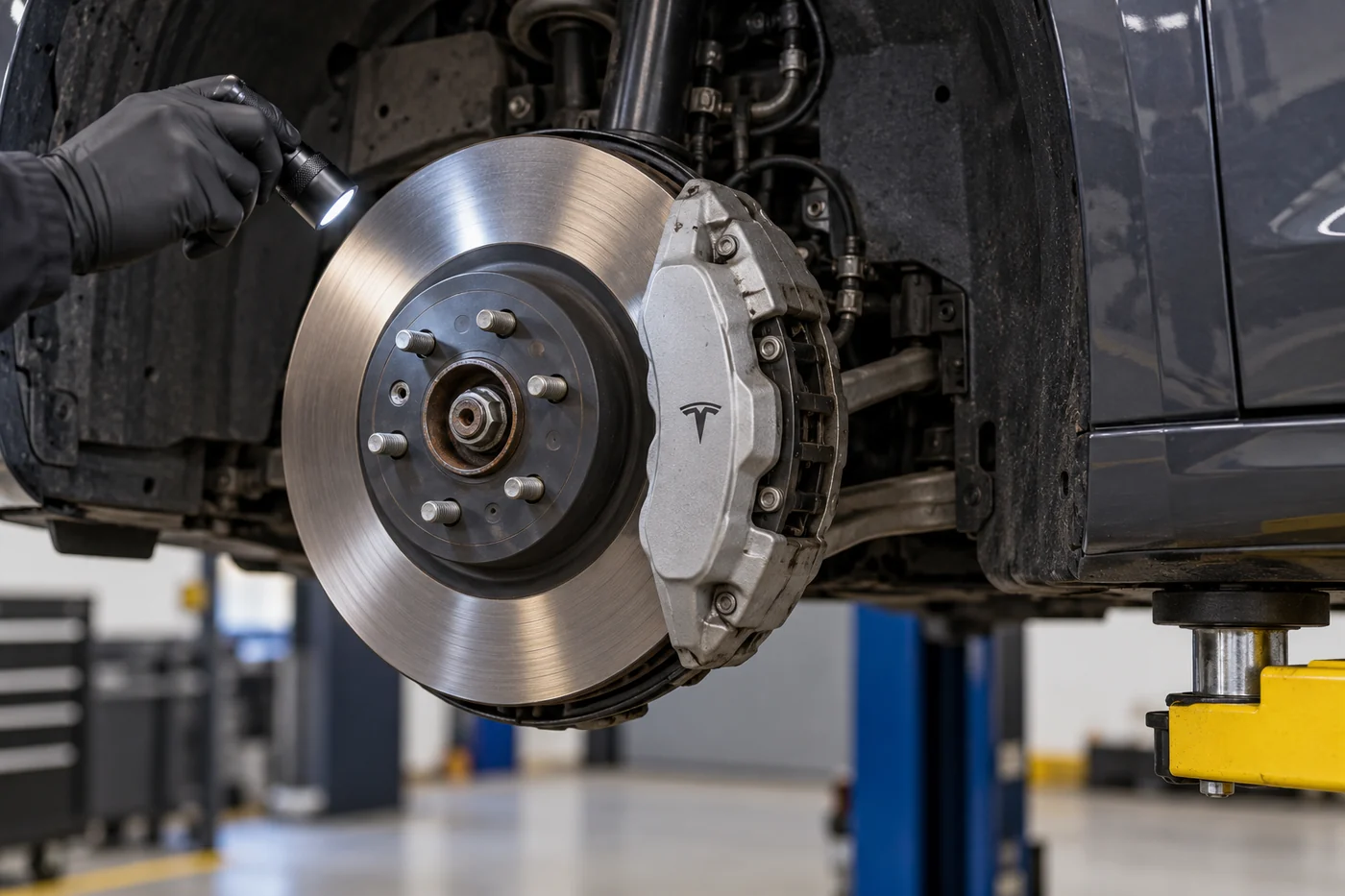
The appropriate inspection should also address the wheel-area or brake concern when your description points there. Ask which finding links a proposed repair to your noise. “A worn part was found” and “this part produces the reported sound” are related questions, but they are not necessarily the same conclusion.
Tesla’s 2024+ Model 3 service guidance distinguishes permissible bushing deformation from damage requiring replacement. It also considers comparison with a suitable reference vehicle when assessing noise. These limits are model-specific. They illustrate why a visible rubber mark or a recording alone cannot justify a universal replacement recommendation.
The same guidance does not require suspension components to be replaced in pairs unless a Tesla Service Bulletin specifies it. Ask for the reason for each proposed part, together with any alignment or calibration required by the applicable repair procedure. There is no basis here for a blanket package of Dubai-specific upgrades.
Before approving work, request the component and side, the observed defect, the proposed correction and how the original complaint will be checked afterward. A useful completion check compares the repaired car with the same safe condition that originally produced the sound. If it persists, ask what remains unresolved rather than treating a parts invoice as confirmation.
Answer common questions about Tesla suspension noises
Can a recording identify the failed control arm?
A recording can show timing and character, but it cannot confirm a failed control arm on its own. The technician must connect the complaint to findings on the actual vehicle and use the applicable inspection procedure.
What if the noise disappears at the workshop?
Provide the original date, conditions and any safe recording. Explain whether it happened only after parking, on a particular surface or during a specific manoeuvre. Ask which checks were completed and what evidence would help investigate it again.
Does a software update rule out mechanical damage?
No. A change in the sound after an update does not confirm that physical components are sound. Record the timing and any changed settings, then assess continuing noises or handling changes on their own evidence.
The useful next step is a clear description of the event, its onset and any change in vehicle behaviour. Keep normal operating examples tied to their stated conditions, and let inspection establish whether a repair is needed.
Official references for identifying noises and inspection
- Tesla Model 3 UAE normal operating sounds
- Tesla Model 3 UAE braking and warnings
- Tesla Model S UAE air suspension
- Tesla Model X UAE air suspension
- Tesla 2017–2023 Model 3 front-suspension inspection
- Tesla 2024+ Model 3 suspension service limits
Use the owner and service information for the vehicle’s actual build, equipment and market. The examples above are not a diagnosis of your car.