Tyres & ownership
Best Tyres for Tesla in the UAE
A new set should suit your car and the way you drive. Compare fitment, cabin comfort, efficiency and grip before paying for a tyre name.
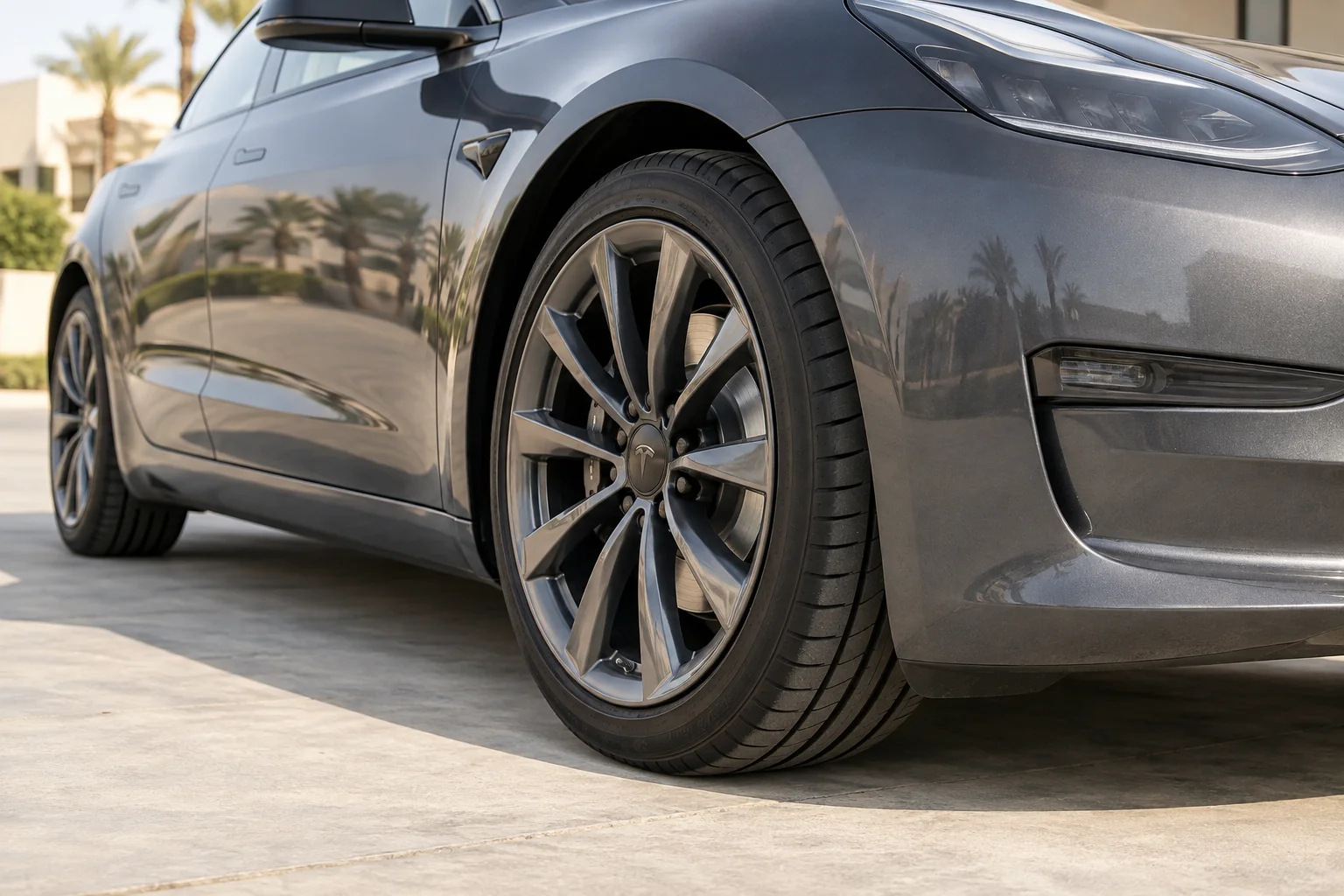
Replacing your Tesla’s tyres can feel like an expensive guess. Will the next set be noisier, affect range or wear differently? The best tyre for a Tesla in the UAE is a compatible tyre in the correct size, load and speed specification, chosen for your priorities. A Tesla-approved replacement matching a set you liked is a useful starting point. Alternatives need a comparison of the exact product, not just the brand.
Hankook iON evo, Michelin Pilot Sport EV and selected Pirelli P Zero ELECT versions are worth considering where a suitable fitment exists. The right choice depends on your Model 3, Y, S or X, its wheels and the way you drive.
Compare suitable tyre options for your Tesla
Start with your car’s required tyre specification, then compare the options below for your driving priorities. Confirm the exact size, version and availability with the supplier before ordering.
| Tyre option | Why consider it? | Check before ordering |
|---|---|---|
| Your original Tesla-approved tyre | A sensible baseline if its comfort, handling and wear suited you. | The full product name, size, ratings and Tesla marking. A familiar brand name alone does not identify the same tyre. |
| Hankook iON evo / iON evo SUV | EV-focused summer ranges positioned around lower rolling resistance, noise control and road grip. | Passenger or SUV range, exact size and label. iON evo and iON evo AS are different products. |
| Michelin Pilot Sport EV | A performance-oriented summer option developed for electric vehicles, with handling and efficiency as design priorities. | Correct fitment and the features of the offered version. Manufacturer range claims are conditional, not a prediction for your car. |
| Pirelli P Zero with ELECT | A performance-focused family with versions developed for electrified vehicles. | Generation, Tesla marking and whether PNCS acoustic technology is included. ELECT and PNCS mean different things. |
Swipe to see all columns.
These options form a shortlist, not a tested ranking or a stock list. Compare the exact products described in Hankook’s iON evo specifications and Michelin’s Pilot Sport EV range. A size offered in a manufacturer catalogue may still need checking for your vehicle and local supply.
Check your exact fitment before choosing tyres
Record your Tesla model, production year, variant and fitted wheel size. Photograph the complete markings on a front tyre and a rear tyre, then check them against the applicable owner’s manual. A previous owner may have changed wheels or fitted an unsuitable tyre, so the current sidewall is a useful reference rather than conclusive approval.
For example, the UAE 2024+ Model 3 wheel and tyre specifications list 235/45R18 and 235/40R19 front and rear, but its 20-inch setup uses 235/35R20 at the front and 275/30R20 at the rear. Those figures must not be applied automatically to an older Model 3.
The 2025+ Model Y UAE specifications also distinguish five-seat, six-seat and Performance configurations. Its five-seat 19-inch specification is 255/45R19 front and rear. The six-seat 19-inch version has 275/45R19 rear tyres. This is why “Model Y, 19-inch” can be an incomplete order.
Read the full specification on your tyre
This specification example shows how much detail sits behind a tyre size. It is a reading example, not a recommendation for every Tesla.
235/40 R19 96W XL T0- 235/40 R19 means 235 mm nominal width, a sidewall height of 40% of that width, radial construction and a 19-inch rim.
- 96W identifies the load index and speed rating. They must meet the vehicle’s requirements. Matching the rim diameter is insufficient.
- XL means extra-load construction. It does not, by itself, mean Tesla-approved.
- T0 is a Tesla-specific approval marking. It does not replace the other fitment checks.
Tesla approval, EV labels and foam
Tesla’s approved-tyre guidance identifies T0 as the first approved version, with T1 and T2 identifying subsequent iterations. Treat the marking as part of the full specification. A higher number is not a reason to buy a tyre in the wrong size or assume that every version is interchangeable.
An EV label describes a manufacturer’s product positioning or technology. It is not a substitute for vehicle compatibility. Michelin’s electric-car tyre guidance explains that suitability is not restricted to tyres with EV in the product name. A correctly specified conventional product may be an option, although its noise, efficiency or handling can differ from the original Tesla-approved tyre.
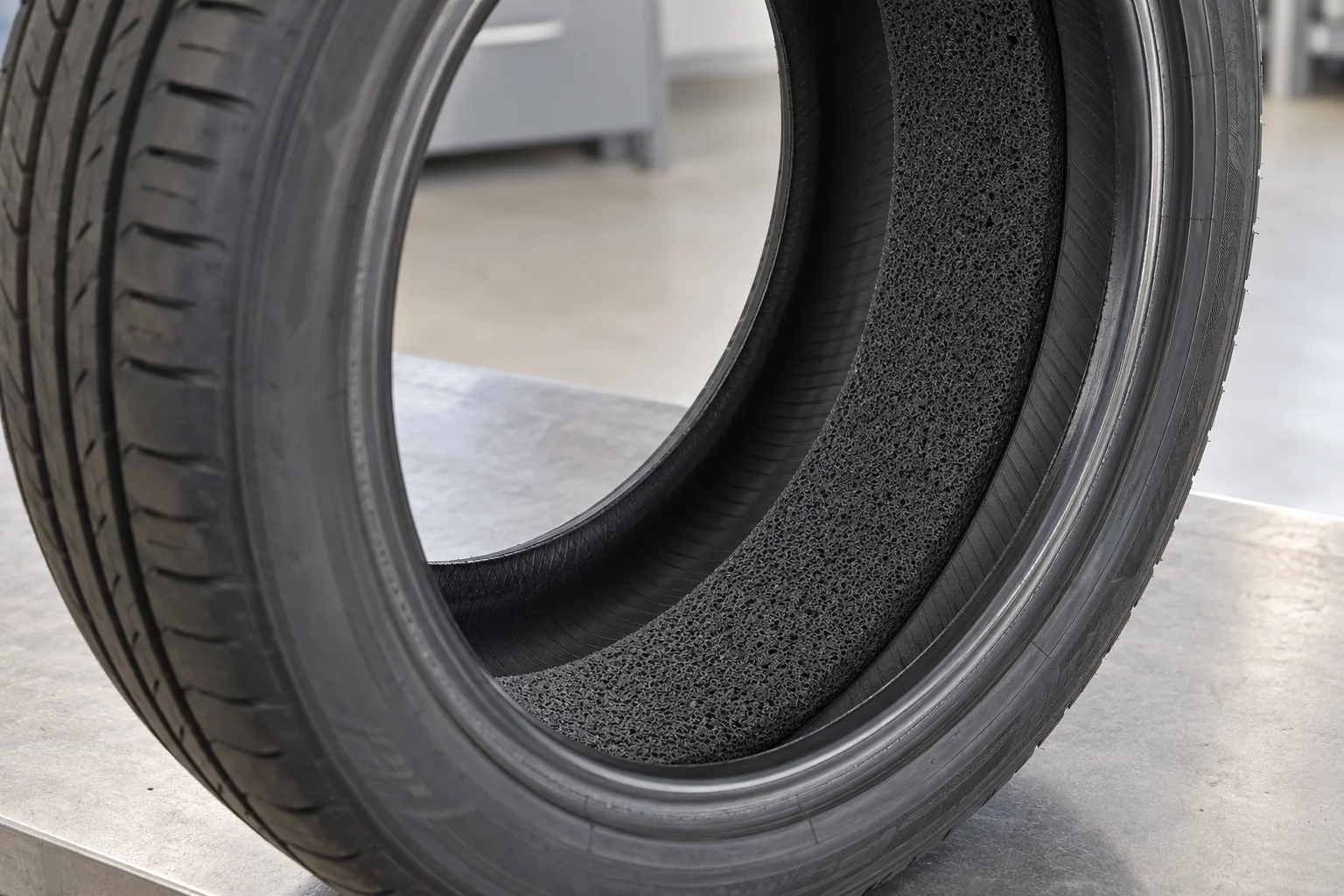
How acoustic foam changes tyre cavity noise
A foam liner helps reduce particular tyre-cavity noise frequencies. It does not make every road surface quiet or establish the tyre’s grip, load capacity or overall comfort.
Pirelli’s ELECT designation relates to its technology for electrified vehicles. PNCS identifies its acoustic system. Check both in the exact product listing if those features matter to you. Do not assume every tyre in the same family contains foam.
Choose tyres around your everyday driving priorities
Once compatibility is established, decide what you want to improve. “Best” becomes a more useful question when it means quieter motorway journeys, predictable wet braking or a familiar steering response.
Choose acoustic features for quieter motorway journeys
Check whether the exact tyre version has acoustic foam and compare cabin-noise results where available. A constant road roar and a new vibration need different checks.
Compare efficiency claims for the exact tyre
Compare rolling-resistance information for the same tyre size and specification. A claimed improvement against a different tyre or laboratory baseline is not your expected range gain.
Check wet grip alongside dry road handling
Compare wet-braking and handling results alongside dry-road performance. Check the exact tyre version when comparing products in the same range.
Understand what the tyre label actually measures
Where an EU tyre label is supplied, it separates rolling resistance, wet grip and external rolling noise. Continental’s label guide explains these measures. The noise figure describes sound outside the vehicle. It is not a cabin-noise score. Check the label for the exact size and version, because a tyre family can contain different ratings.
Compare labels for the same tyre size and specification. Read any range claim alongside its test conditions, since your driving, tyre pressure and road conditions affect the result. Ask the supplier for the complete product name and version before comparing prices.
Choose grip for dry and wet roads
A suitable summer road tyre can make sense for warm-weather UAE use. An all-season tyre can also be a compatible choice. The category alone does not decide which product is better. Tesla notes that tyre type varies with model and market, and summer tyres lose traction in low temperatures. Consider the conditions on any journeys outside your normal UAE driving area too.
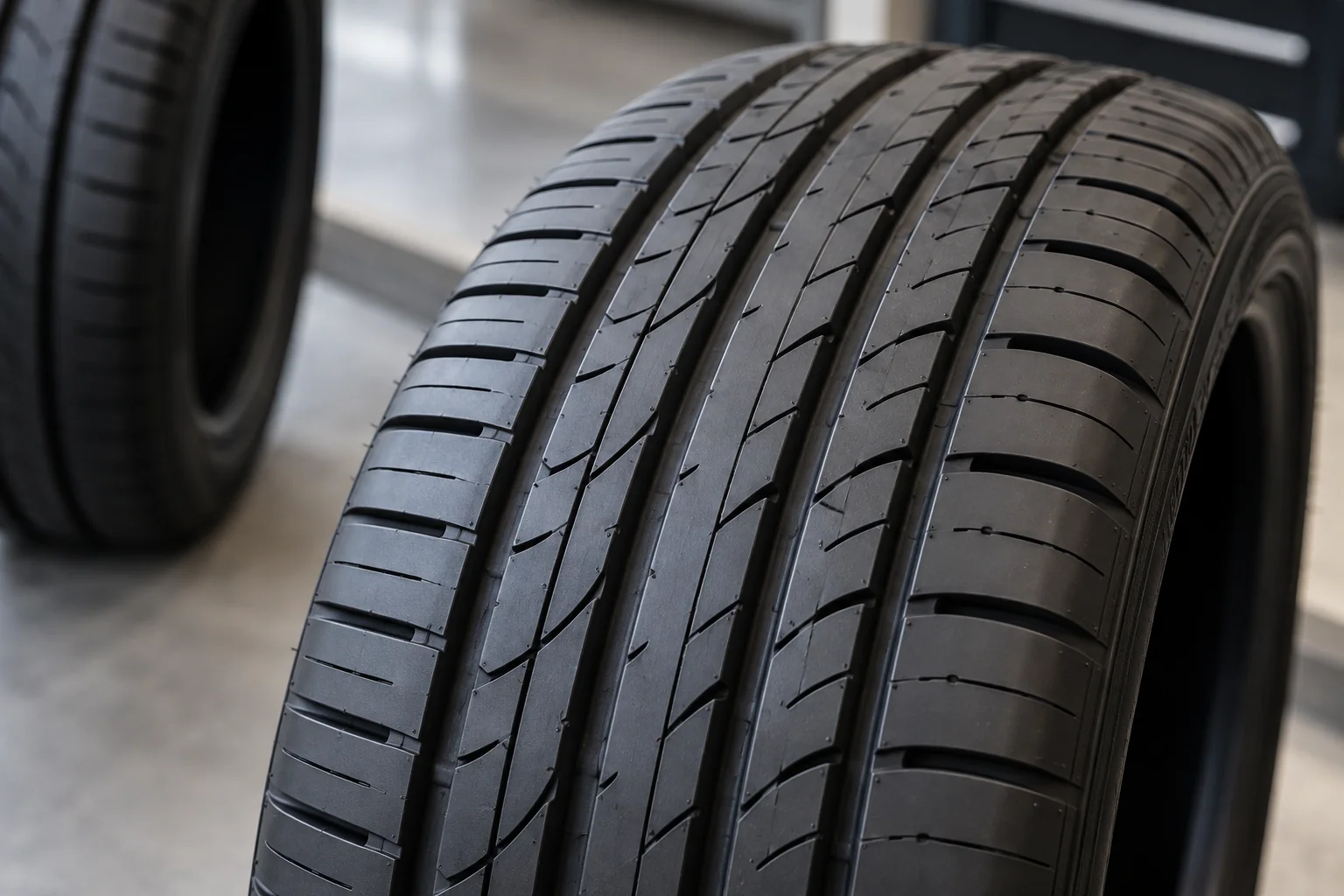
Do not dismiss wet grip because most of your mileage is on dry roads. Check the proposed tyre’s wet-grip rating and inspect the tyres already on the car. A “summer” label does not mean a tyre is intended only for dry surfaces.
Likewise, a UTQG temperature grade is a laboratory heat-resistance classification, not a special UAE approval. A treadwear grade is a comparative test rating, not a promised lifespan in kilometres. NHTSA’s tyre guidance explains both. Neither gives a sound basis for a blanket rule that every Tesla needs a particular treadwear number.
Protect your next set with regular checks
Maintenance affects the result you get from any suitable tyre. For current Model Y configurations, Tesla’s UAE tyre-care instructions cover the following checks. Follow your own vehicle’s manual where it differs.
- Set pressure cold. Use the vehicle’s tyre-information label, not the maximum figure on the sidewall. Tesla describes checking after the car has stood for over three hours. Do not release air from warm tyres to make them match a cold-pressure target.
- Check the whole tread. Include the inner shoulders. Uneven wear or a pull to one side warrants a wheel alignment check. Vibration can warrant a balance check. Tesla also recommends alignment after a new set.
- Respect rotation limits. The recommendation is every 10,000 km or when the tread-depth difference reaches at least 1.5 mm since the last rotation, whichever comes first. Different front and rear sizes cannot swap front-to-back. Directionality also affects permitted movement.
- Act on damage. Do not continue driving on a tyre with a bulge, exposed cords or other damage. Arrange appropriate assistance and inspection.
Ask the fitter to follow the vehicle’s applicable tyre-configuration and pressure-monitoring procedure after replacement. Tesla configurations differ, so a generic promise to “reset every TPMS sensor” does not describe every car.
Check tyre age before paying for replacements
The final four digits of a DOT date code identify the manufacturing week and year. Record the date alongside the product details and ask about storage and warranty terms. Age, damage and condition all matter. A manufacturing date alone cannot tell you how many kilometres the tyre will last.
For Dubai vehicle renewal, RTA’s tyre-validity guidance states a maximum of five years from manufacture. Damaged tyres need replacement to pass inspection even before that limit. This is a maximum validity period, not a promise of five years of safe use. Check the date before accepting stock, and address wear or damage earlier.
Compare complete tyre quotations before you buy
A lower total is only meaningful when you know what is included. Use this checklist when comparing offers for the same car.
If your budget is tight, ask for compatible alternatives with the same load and speed requirements and compare their complete fitted totals. You do not have to choose the most expensive tyre, but an incorrect specification is not a useful saving. Keep the exact product and its warranty terms in writing.
- Identify the vehicle. Record the model, year, variant, wheel size and any changed wheels. Confirm front and rear requirements separately.
- Name the complete product. Brand, range, generation, size, load and speed ratings, load range, Tesla marking and acoustic version where applicable.
- Confirm what will arrive. Quantity, production dates, availability and the applicable supplier or manufacturer warranty.
- Separate tyres from fitting. Ask whether balancing, valves or required sensor work, old-tyre disposal and alignment are included or quoted separately.
- Compare the payable total. Have VAT treatment and any additional charges stated clearly.
Keep a photo of the agreed specification and check the supplied tyres against it before fitting. If an alternative is offered on the day, compare its complete specification again. “Same brand, same size” can still mean a different product.
Ask which tyre faults the written warranty covers, who handles a claim and what evidence they need. Manufacturing-defect cover, puncture protection and fitting workmanship are separate questions; do not assume all three come with the tyre.
Need help checking your tyre options?
Send Tesla Repair Dubai your model, year and clear photos of the front and rear tyre markings. Ask us to confirm compatible options and a fitting quotation with the inclusions stated. If damage prompted the purchase, arrange a tyre repair assessment before deciding whether replacement is necessary.
Answers to common Tesla tyre buying questions
Can I replace only one Tesla tyre?
It depends on the remaining tyres and the applicable Tesla guidance. The current Model 3 manual recommends replacement in pairs unless the other tyres are within 1.5 mm of the new tyre’s tread depth. Match the brand, tyre model and required specification, and have the remaining tread measured. Where all four tyres are the same size, Tesla says a new pair should go on the rear. A staggered setup needs axle-specific advice.
Should a Tesla Performance model use a different tyre?
Check the Performance variant’s actual wheel, axle and tyre requirements. For example, the current Model 3 20-inch setup has different front and rear sizes. Do not order from a standard-model listing simply because both cars carry the Model 3 name.
Will changing tyres fix a new vibration?
A tyre purchase is not a diagnosis. The current Model 3 manual identifies wheel imbalance and tyre damage among issues needing attention. Have a new vibration assessed before assuming a quieter tyre will solve it. If the tyre may be damaged or the ride suddenly changes, slow down, stop safely and arrange inspection or transport as appropriate.
Is there one correct Tesla tyre pressure for Dubai?
No single figure covers every Tesla and wheel configuration. Use the tyre-information label and the guidance for the wheels fitted to your car. Check pressure when cold. Do not substitute a value from another model or the tyre sidewall’s maximum pressure.