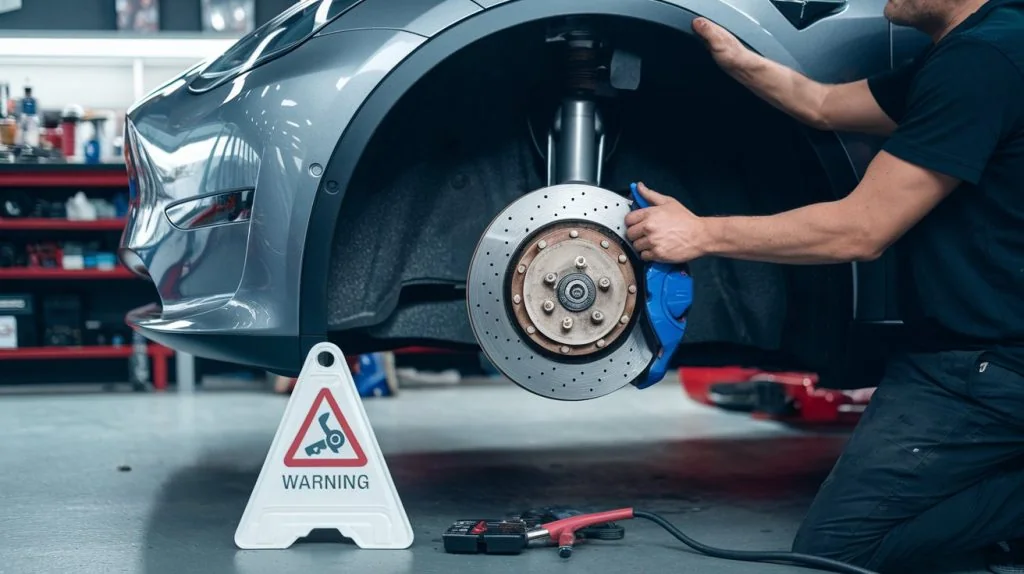
Tesla ownership · Wheels and tyres
Tesla Rim Scratch Repair in UAE and When to Replace a Wheel
Kerb rash may only affect the finish, but a bent wheel or damaged tyre changes the decision. Learn what to check before choosing cosmetic repair or replacement.
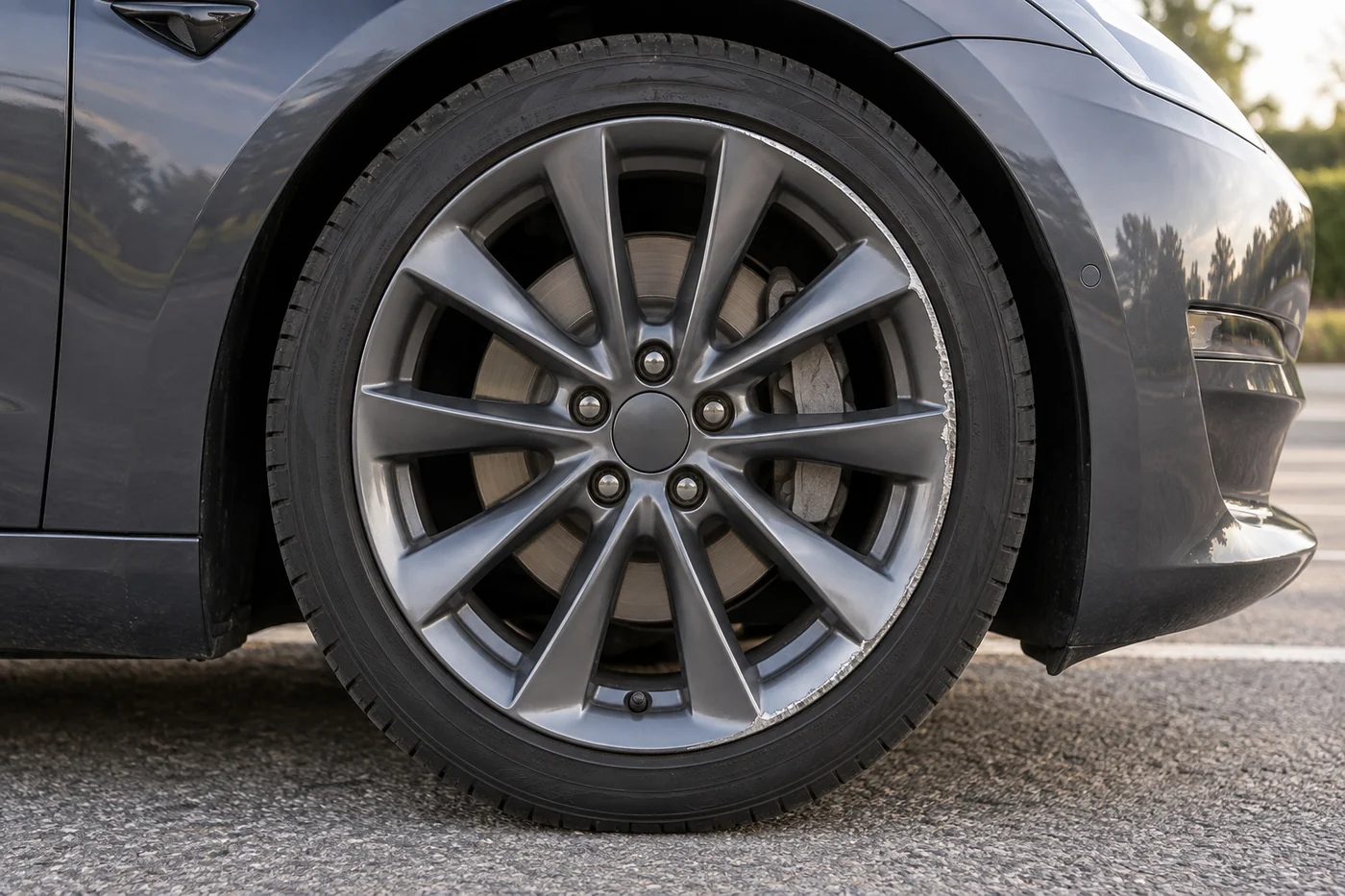
A kerb scrape can make a Tesla wheel look badly damaged even when the problem is mainly cosmetic. The decision changes if the same impact has bent the wheel, cut the tyre or caused a pressure loss. Before choosing a repair, separate the visible finish damage from anything that could affect the wheel’s strength or ability to hold a tyre securely.
Light damage to a suitable painted surface may be a candidate for cosmetic refinishing. A cracked or distorted Tesla-provided wheel should not be treated as an ordinary scratch repair. Tesla’s published wheel guidance excludes welding, crack repairs, straightening, bending and machining. A replacement assessment is therefore a different route from disguising the damage with fresh paint.
Is the scratch on the wheel or its cover?
Some Tesla wheel designs use a removable aerodynamic cover over an alloy wheel. Others expose the finished alloy directly. A scrape on a plastic cover and a gouge in the wheel beneath it can look similar in a close photograph, but they involve different parts.
Start with a wider view of the wheel. Identify whether the damaged edge belongs to the cover, the alloy or both. Do not assume that the cover absorbed the entire impact. If removal is needed for inspection, use the procedure for the fitted design because retention clips and removal methods vary.
- Cover damage: A replaceable cosmetic cover may be scuffed or have damaged clips while the wheel underneath remains sound.
- Finish damage: A scratch may remove paint from an otherwise sound wheel surface.
- Material damage: A deep gouge, crack or change of shape needs an assessment beyond paintwork.
The tyre deserves attention at the same time. The wheel lip may show the most visible mark while the rubber next to it has taken a concentrated impact. Treat the wheel and tyre as an assembly during the initial inspection, even if you originally noticed only a silver line around the rim.

When a scuffed rim needs more than cosmetic attention
A superficial scrape alone does not establish that the vehicle is unsafe. Equally, a tidy-looking outer face cannot rule out damage on the inner barrel or tyre. What happened during the impact and what changed afterwards are useful parts of the assessment.
| Observation | What it suggests | Next step |
|---|---|---|
| Paint abrasion with normal pressure and no new symptoms | Possibly cosmetic damage | Arrange a wheel and tyre condition check before choosing a finish repair |
| Crack, visible distortion or a displaced rim edge | Potential structural damage | Avoid driving and arrange professional assessment or recovery |
| Tyre bulge, exposed cords or substantial cut | Possible tyre failure risk | Do not continue driving on the affected tyre |
| Pressure loss after the impact | A leak requiring diagnosis | Have the tyre, valve and wheel checked rather than repeatedly adding air |
| New vibration, pulling or unusual noise | Possible wheel, tyre or suspension involvement | Stop safely and seek advice about inspection and transport |
Swipe to read the full table.
Do not take the car onto a motorway to see whether a vibration gets worse. That turns a concern into a higher-speed test without establishing what failed. Record symptoms already experienced and let the inspection determine whether driving is appropriate.
A tyre pressure reading is only one piece of information. A tyre can have impact damage without an immediate pressure warning. If there is visible structural damage, the absence of a dashboard alert does not make the assembly acceptable to use.
What Tesla’s wheel repair limits mean for your options
Tesla’s published collision guidance for its supplied wheels does not approve reconditioned wheels or chrome-plated original equipment wheels. It also rules out the structural repair processes listed above. That matters when a generic alloy repair advertisement offers to straighten, weld or machine almost any wheel.
Cosmetic refinishing and structural restoration are different operations. Applying an appropriate finish to an eligible surface does not correct a bent barrel, replace missing structural material or restore a cracked spoke. A wheel should first be judged suitable for the proposed cosmetic work.
Why a diamond-cut service is not a default Tesla repair
Diamond cutting uses machining to renew a wheel face. Its availability at an alloy repair business does not establish that it is permitted for a particular Tesla-provided wheel. Do not choose it simply because the original finish looks bright or machined. Confirm the wheel identity and applicable restrictions first.
Aftermarket wheels need their own information
An aftermarket wheel may have different construction, coating and manufacturer requirements. Identify its maker and specification rather than applying a generic Tesla paint recipe. If its identity or repair history is unclear, that uncertainty belongs in the replacement decision.
The practical distinction is straightforward. A method that improves appearance is only useful when the component remains appropriate for service. A freshly painted wheel should never be taken as evidence that a structural repair method was acceptable.
Comparing cosmetic options for a sound wheel
Leave a minor mark until a convenient time
Once the assembly is confirmed sound, a small cosmetic mark can be an appearance decision. It may bother you every time you wash the car, or it may be too slight to justify refinishing immediately. There is no need to invent a safety emergency around every superficial paint scuff.
Keeping a clear photo gives you a reference for later comparison. Clean the wheel normally and watch for a change in the coating rather than repeatedly rubbing the same spot with an abrasive product. Any new crack, pressure issue or driving symptom needs a separate assessment.
Use a suitable touch-up for a modest visual improvement
A compatible touch-up may reduce the contrast of a small exposed mark on an eligible painted surface. It usually does not recreate the original texture perfectly, particularly around a rough edge. The goal is a less noticeable mark, not a claim that the wheel is indistinguishable from new.
A touch-up product is not a crack filler or a way to conceal a deep gouge. Avoid aggressive sanding, grinding or adding material to reshape the rim as a home repair. Those actions can move the job beyond a cosmetic coating decision.
Consider refinishing when the damaged area is broader
Several scuffed sections or an inconsistent old finish may justify a more complete cosmetic refinish, provided the wheel is eligible. The process needs appropriate preparation, compatible materials and protection of surfaces that must remain free of coating.
Tesla specifically requires masking of wheel mounting surfaces, lug nut contact areas and the central locating hole before paint or clear coat application. These are functional interfaces, so a job should not be judged only by the visible spokes.
Matching the wheel finish without changing its character
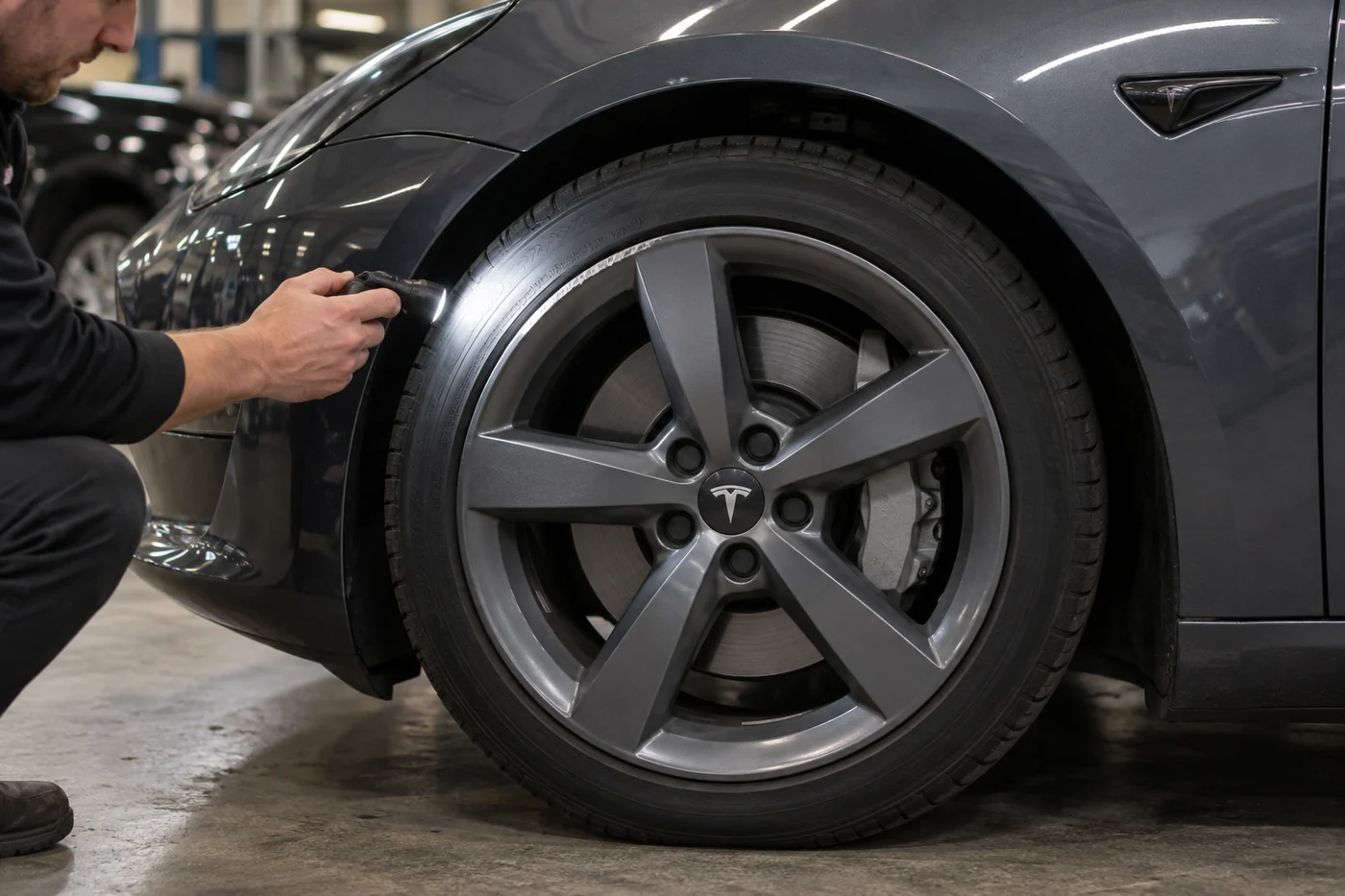
Wheel size and colour name are not enough to select a matching finish. The exact wheel design, model year, original part and any previous repainting matter. Covers and the alloys beneath them can also have separate colour specifications.
Tesla publishes vehicle and wheel paint information, but the wheel fitted to your car still needs identification. A previous owner may have changed the wheels or refinished them. Matching a catalogue description without inspecting the existing set could produce a visibly different result.
- Shade and effect: Compare the repaired wheel with the other wheels in useful daylight.
- Gloss level: A satin finish can look wrong when restored with a much glossier surface.
- Coverage: Agree whether the work concerns a small area, the visible face or other eligible painted surfaces.
Imagine one dark grey wheel beside three wheels with a softer satin sheen. The colour can be close while the mismatch remains obvious. That is why finish selection should consider the whole set without automatically repainting all four.
Existing brake dust can also make an unrepaired wheel look darker. Comparisons are more useful after appropriate cleaning. Strong chemicals or polishing intended for a different surface can create another problem instead of revealing the original colour.
When replacement makes more sense
A wheel with prohibited structural repair needs, uncertain previous reconditioning or damage outside the acceptable cosmetic scope may need replacement. This is not a reason to replace every scratched wheel. It is a reason to base the decision on the actual component rather than the size of the paint mark.
A replacement must suit the vehicle and axle. Diameter is only one part of compatibility. Width, offset, load suitability, brake clearance, tyre fitment and the correct mounting arrangement also matter. Some configurations use different front and rear specifications.
If the tyre was damaged too, choose its replacement using the vehicle’s approved fitment information. The Tesla tyre selection guide explains how size, load rating and other requirements fit into that decision.
For a used replacement, a good photograph and fresh paint are not enough to establish condition. The wheel’s identity, history and inspection remain relevant. An apparently inexpensive wheel becomes a poor choice if it introduces uncertainty about strength or fitment.

What a useful inspection and refitting should cover
The inspection should follow the impact, not just the visible scuff. A light parking scrape and a hard pothole strike can leave similar paint damage while putting different loads through the assembly. Describe the event as accurately as you can without guessing at hidden damage.
- Identify the parts: Establish the wheel design, tyre specification and whether a removable cover is involved.
- Assess the impact: Inspect relevant visible and hidden surfaces, tyre condition and any reported pressure or vibration issue.
- Select the route: Separate acceptable cosmetic work from components needing replacement or further diagnosis.
- Complete the refitting: Use the vehicle-specific fitting procedure and address tyre, valve or balance requirements affected by the work.
Balancing and wheel alignment solve different problems. Balancing concerns the rotating assembly. Alignment concerns wheel angles relative to the vehicle. Neither should be sold as an automatic cure for a bent wheel or damaged tyre, and neither follows from every superficial scrape.
Similarly, a tyre pressure monitoring warning after wheel work needs interpretation. The cause may concern pressure, the sensor or another relevant condition. Do not accept clearing the warning as proof that all parts were inspected and fitted correctly.
How to compare the scope of two estimates
Separate the cosmetic work from tyre removal, valve work, balancing, replacement parts and any further inspection. Two totals can differ because one covers a small touch-up and the other covers a broader refinish. A fixed per-wheel price has little meaning without those boundaries.
Time depends on preparation, material requirements and any replacement component needed. A same-day promise should not override drying or inspection requirements. For a daily driver, the practical question is when the complete assembly will be ready for use, not simply when its paint will look dry.
Reducing repeat kerb damage
Leave a little more clearance than you think you need when turning beside a high kerb. The rear wheel follows a different path from the front, so successfully clearing the obstacle with the front corner does not prove the rear rim will clear it too.
Use mirrors and camera views as aids, while keeping the actual surroundings in view. Camera perspective, lighting and an obscured kerb can make a gap difficult to judge. If the manoeuvre feels too tight, stop and reset the approach instead of trying to recover it with a sudden steering correction.
- Use the specified tyre pressures rather than changing them to create supposed rim protection.
- Clean wheels with products and tools suitable for their finish.
- Remove loose grit before wiping or brushing the surface.
- Inspect a new scrape before fitting a cosmetic accessory over it.
A rim protector or wider-looking tyre is not permission to touch kerbs. Accessories need to suit the wheel and tyre assembly, and they should not hide existing damage. Prevention remains mainly a matter of clearance, visibility and a slow, deliberate parking approach.
Questions about Tesla rim scratches
Can all Tesla kerb rash be repaired?
No. Superficial finish damage may be suitable for cosmetic work after inspection. Deep damage, cracks or distortion require a different decision. Tesla’s restrictions on its supplied wheels mean that commonly advertised welding, straightening and machining methods cannot be assumed acceptable.
Can I drive with a scratched rim?
A confirmed cosmetic scuff is different from an impact-damaged assembly. Do not drive if there is a crack, visible deformation, tyre bulge, serious cut or pressure loss. New vibration or steering changes also need prompt assessment. The photo of the scratch alone cannot settle that question.
Does the whole wheel need painting?
Not necessarily. A small compatible touch-up may be enough for your appearance goal. A broader refinish can be considered for wider eligible finish damage. The selected process must preserve the wheel’s functional surfaces and must not conceal unacceptable structural damage.
Will a scratched aero cover require a new alloy wheel?
Not when the damage is limited to a replaceable cover and the wheel and tyre are sound. Check the cover’s retention as well as its appearance. An impact can affect more than one part, so do not make the decision from the outer cover alone.
Will painting remove a vibration?
No. Paint changes the finish. Vibration can involve the tyre, wheel, balance or other components and needs its own diagnosis. A visually restored rim does not demonstrate that the cause of a vibration has been corrected.
Unsure whether your wheel needs refinishing or replacement?
Tesla Repair Dubai can assess the assembly before discussing Tesla rim repair options. Send a full wheel photo, a close view and any pressure loss or driving symptoms. Arrange safe transport if the damage makes driving uncertain.